

Copper-Nickel Pipes Standards
As core corrosion-resistant piping materials for seawater systems, heat exchangers, and marine engineering, copper-nickel pipes are governed by multiple parallel standard systems worldwide. These standards differ in their emphasis on alloy grades, dimensional tolerances, testing requirements, and certification rules—factors that directly influence procurement selection and project compliance.
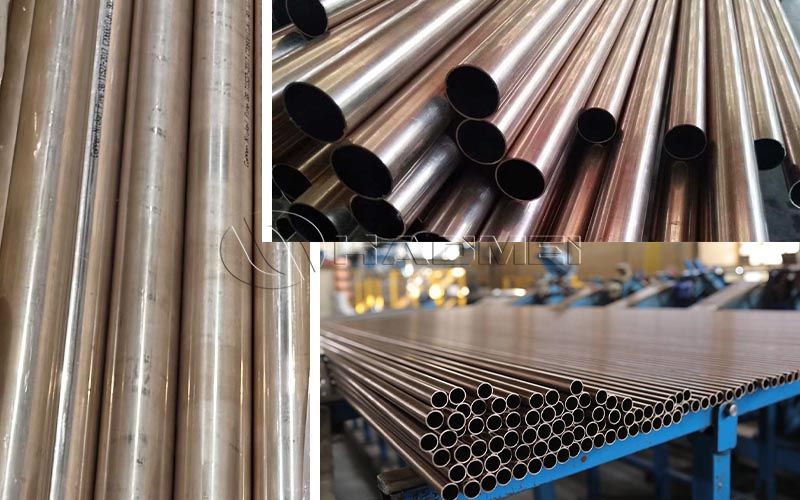
The North American standard system serves as the most widely used global benchmark, comprising ASTM material standards and ASME pressure equipment standards.
Within the ASTM standards, ASTM B466 is the primary standard for seamless copper-nickel alloy pipes; it covers the two mainstream grades—UNS C70600 (90/10) and UNS C71500 (70/30)—and specifies mandatory requirements for chemical composition, room-temperature mechanical properties, hydrostatic testing, and eddy current testing. ASTM B467 covers welded copper-nickel pipes, suitable for large-diameter, low-to-medium pressure piping applications, while ASTM B111 sets specific technical requirements for precision small-diameter tubes used in condensers and heat exchangers.
The ASME standards builds upon ASTM standards to derive ASME SB-466 and SB-467 (standards for boiler and pressure vessel piping), which introduce additional requirements for material evaluation and batch inspection of pressure equipment; these are mandatory standards for pressure vessel and power piping projects. Pipe fitting dimensions adhere to the ASME B16.9 standard for factory-made wrought butt-welding fittings.
The European standard system centers on harmonized EU standards, with national standards from member states also in use.
EN 12451 is the harmonized EU standard for seamless copper-nickel pipes; it employs a composition-based designation system—specifically CuNi10Fe1Mn and CuNi30Mn1Fe, corresponding to the 90/10 and 70/30 alloy systems—and covers the entire process, including dimensional tolerances, manufacturing methods, and performance testing.
Within the German DIN system, DIN 1785 sets specific requirements for copper-nickel tubes used in condensers and heat exchangers, while DIN 17664 defines the material specifications for CuNi30Mn1Fe (material number 2.0882).
The British standard BS 2871 classifies copper-nickel alloys into two grades—CN102 and CN107—corresponding to the 90/10 and 70/30 alloys, respectively.
Regarding certification, EN 10204 is the standard for material inspection certificates across Europe; Grade 3.1 represents a manufacturer's self-inspection certificate, while Grade 3.2 signifies a certificate based on third-party witnessed inspection—a standard requirement for classed marine vessels and offshore engineering projects.
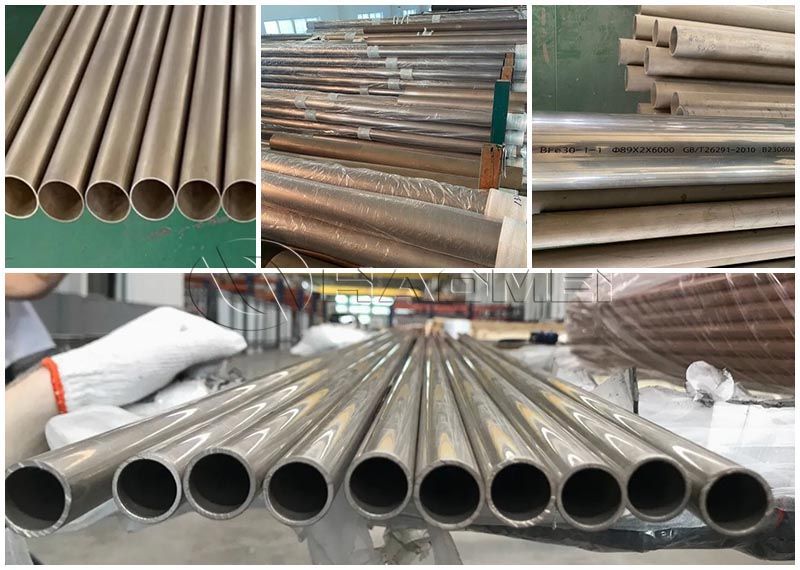
In the Asia-Pacific and international standards landscape, Japan's JIS H3300 is widely used in East Asia, featuring alloy designations C7060 and C7150 with technical requirements largely aligned with the ASTM system. International ISO standards designate alloys directly by their chemical composition (e.g., CuNi10Fe1Mn, CuNi30Fe1Mn), serving as a globally recognized compositional benchmark and a reference for the adoption of national standards.
Based on years of export experience, the selection of project standards generally follows two principles:
First, the principle of regional acceptance—prioritizing ASTM/ASME standards for North American projects, EN/DIN standards for European projects, and ASTM or JIS standards for Southeast Asian projects.
Second, the principle of grade matching—selecting seamless pipe standards for critical high-pressure piping and welded pipe standards for large-diameter, low-pressure piping.
It is important to note that different standards may have slight variations in permissible compositional tolerances for the same alloy; for instance, the nickel content range for the 70/30 alloy is 29%–33% under ASTM but 30%–32% under EN. Such details should be clarified during the procurement phase to avoid compliance disputes upon delivery.
 |

Haomei Aluminum CO., LTD.

|

|
Company name: Haomei Aluminum CO., LTD.. Tel : +86-18137889531 Whatsapp : +86-18137889531 E-mail : nydia@aluminumhm.com