

90/10 Copper Nickel Pipes and Fittings
As a professional manufacturer of copper nickel pipes and fittings, 90/10 copper-nickel (UNS C70600 / BFe10-1-1) is our core product category with the largest usage and most complete supporting system in our marine and offshore engineering product line. This alloy uses 90% copper and 10% nickel as the base, supplemented with iron and manganese to regulate performance, balancing corrosion resistance, fouling resistance, formability, and weldability. It is the standard material for seawater pipeline systems. Unlike single pipe suppliers, we provide a full range of supporting solutions from main pipes to various connecting fittings, ensuring complete consistency in material properties, corrosion potential, and pressure rating within the same pipeline system, thus avoiding the risks of dissimilar metal contact corrosion and fitting compatibility issues from the outset.
From an alloy composition design perspective, the performance boundaries of 90/10 copper-nickel are determined by the precise control of trace elements. The nickel content is 9.5%~10.5%, primarily serving to enhance the stability of the passivation film and the overall strength of the alloy. The iron content is 1.0%~1.8%, a key element resisting high-speed seawater erosion and corrosion, significantly inhibiting erosion and wear in turbulent zones and bends. The manganese content is 0.5%~1.0%, used for deoxidation and desulfurization and improving hot working performance. Our smelting process strictly controls the content of impurities such as carbon and sulfur to below 0.05%, avoiding the precipitation of brittle phases at grain boundaries and ensuring that the corrosion resistance of the heat-affected zone does not significantly decrease after welding. The finished alloy has a tensile strength ≥275MPa, a yield strength ≥105MPa, and an elongation ≥30%. In seawater at room temperature, the annual corrosion rate is less than 0.02mm, and the designed service life can reach over 20 years.
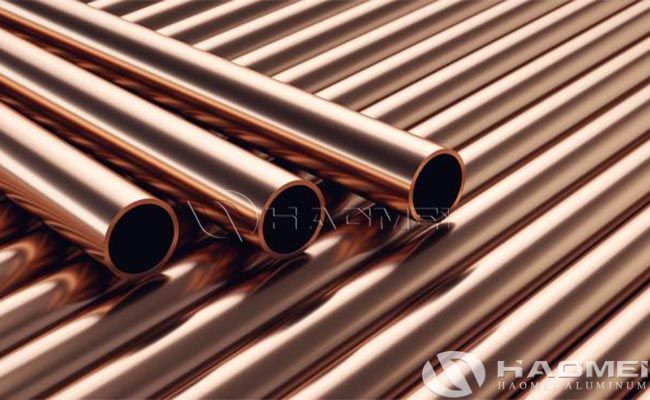
The copper nickel pipe products cover both seamless and welded pipe manufacturing processes, suitable for different pipe diameters and pressure ratings.
Seamless pipes are manufactured using a hot extrusion piercing and multi-pass cold drawing process. Diameters range from Φ6mm (small-diameter instrument tubing) to Φ273mm (large-diameter main pipelines), with wall thicknesses from 1mm to 15mm. They possess strong pressure resistance and are suitable for core pipelines such as high-pressure seawater cooling and fire-fighting water injection, conforming to ASTM B466 / GB/T 8890 standards.
Welded pipes are automatically welded from high-quality copper-nickel strip plates using TIG welding. Diameters range from Φ100mm to Φ630mm, with uniform wall thickness and good straightness. They are suitable for medium-to-low pressure applications such as high-flow water supply and drainage and seawater desalination main pipelines, conforming to ASTM B467 standards.
Both types of pipes can be supplied with pickled and passivated or bright annealed surface finishes upon request, and are available in both fixed length and coil delivery formats.
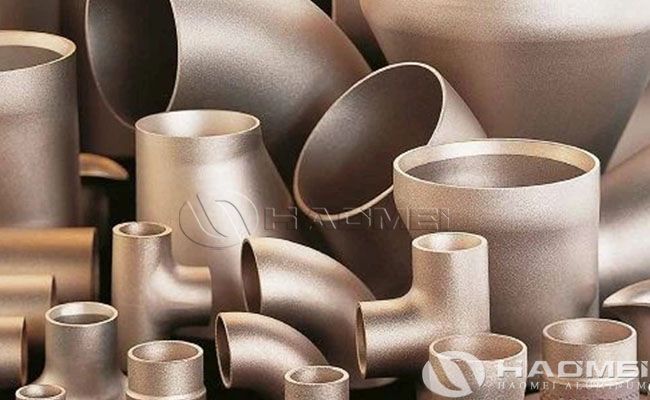
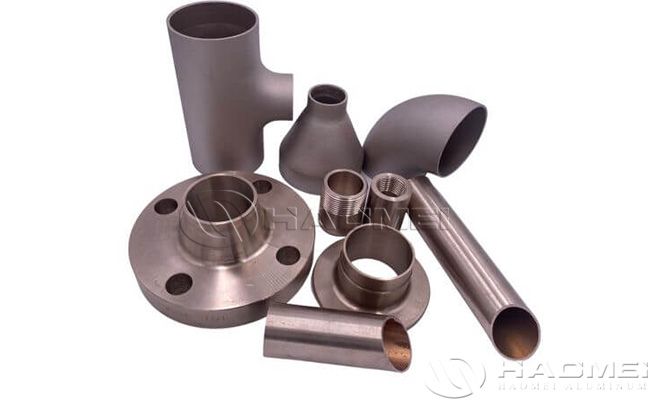
The completeness of the supporting pipe fitting system is crucial for the reliable operation of marine pipelines and is also a core indicator of the manufacturer's supply capabilities. Our 90/10 copper nickel pipe fittings product line covers a full range of connection accessories, including butt-welded elbows (90°, 45°, 180°, long radius/short radius), equal and reducing tees, concentric/eccentric reducers, pipe caps, flanges, and copper-nickel flanges, slip-on flanges, etc. All are manufactured using alloy raw materials from the same furnace as the pipes and comply with ASME B16.9 and B16.5 standards. Elbows are formed using a hot-push process, with wall thickness reduction controlled within 10%, and the back streamline is complete and crack-free. Tees are formed using a hydraulic expansion and local reinforcement process, ensuring that the pressure-bearing capacity at branch junctions is no less than that of the main pipe. The entire series of fittings is supplied in conjunction with the pipes, ensuring precise matching of weld bevels and uniform corrosion potential, avoiding the electrochemical corrosion risks associated with welding dissimilar materials on-site.
Quality control is implemented throughout the entire process from smelting to finished product. Vacuum induction melting with chemical composition spectral verification, dimensional inspection of each piece during extrusion and molding, and eddy current testing and hydrostatic testing of each finished product are all conducted. Key batches undergo additional intergranular corrosion testing and flaring and flattening process performance testing. Products are available with factory approval certificates from classification societies such as DNV, ABS, and CCS, as well as EN 10204 3.1/3.2 material certificates. They are widely used in offshore platforms, ship piping systems, coastal power plants, seawater desalination, and coastal municipal engineering projects. As the original manufacturer, we support non-standard specification customization and rapid small-batch trial production. Our integrated supply model significantly reduces the selection, coordination, and on-site adaptation costs for purchasers.
 |

Haomei Aluminum CO., LTD.

|

|
Company name: Haomei Aluminum CO., LTD.. Tel : +86-18137889531 Whatsapp : +86-18137889531 E-mail : nydia@aluminumhm.com