

Copper Nickel Pipe For Seawater System
Seawater systems are the "vascular network" of ships and offshore platforms, encompassing multiple subsystems such as cooling, fire protection, ballast, desalination, and domestic water supply. The operating conditions of each pipeline differ significantly, requiring different corrosion resistance, pressure capacity, and flow velocity adaptability from the pipe materials. Copper-nickel pipes, with their comprehensive characteristics of seawater corrosion resistance, biofouling resistance, and stable long-term operating resistance, have become the preferred pipe material for various seawater systems. However, actual selection is not a "one-size-fits-all" approach. It requires a tiered matching based on the operating pressure, medium flow rate, start-up and shutdown frequency, and installation location of each subsystem to achieve optimal life-cycle cost while ensuring reliability.
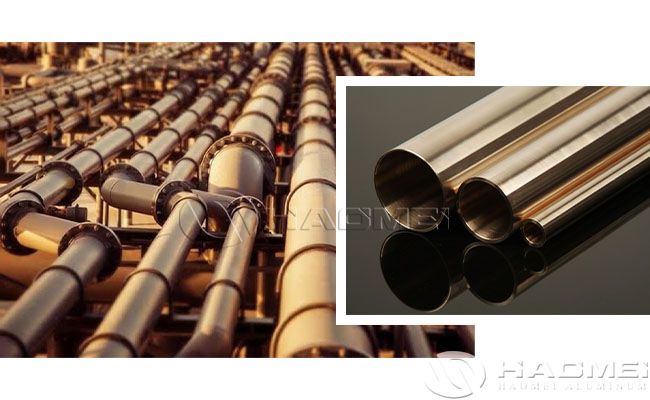
From the underlying logic of corrosion adaptability, the advantage of copper-nickel alloys in seawater environments stems from the self-healing mechanism of the passivation film. After contact with seawater, the copper nickel pipe material will form a dense protective film within 2-3 months, based on cuprous oxide and combined with nickel-iron oxide. Under normal operating conditions, the annual corrosion rate is less than 0.02 mm, and the service life can reach over 20 years. Simultaneously, the slow release of trace copper ions can inhibit the attachment of marine organisms such as barnacles and mussels, preventing scale buildup that could lead to reduced flow diameter and increased pressure drop during long-term operation. This is particularly crucial for continuously operating cooling systems. However, the stability of the passivation film is affected by flow rate, temperature, and sand content, requiring different grades and wall thicknesses for different subsystems.
The main seawater cooling system operates under the most demanding conditions on the entire ship, typically running continuously with high media flow rates and experiencing temperature fluctuations at the main engine end. For this system, 70/30 copper-nickel alloy (C71500) seamless pipe is recommended, especially in areas with flow rates exceeding 2.5 m/s or high sand content, where its resistance to erosion corrosion is significantly superior to 90/10 grade copper-nickel pipe. For medium-to-low load cooling circuits with stable flow rates below 2 m/s, 90/10 copper-nickel (C70600) seamless pipe offers better cost-effectiveness. During the design phase, the flow velocity in straight pipe sections must be strictly controlled: no more than 2.5 m/s for 90/10 copper-nickel alloy and no more than 3 m/s for 70/30 copper-nickel alloy. In localized turbulent areas such as elbows and tees, the pipe diameter should be appropriately increased to reduce velocity and prevent accelerated erosion corrosion that could damage the passivation film.
Firefighting and ballast water systems are high-flow, intermittently operating pipelines with frequent start-ups and shutdowns and prolonged periods of semi-empty operation. The corrosion risk in areas with alternating wet and dry conditions is higher than in fully submerged areas. For these systems, 90/10 copper-nickel seamless pipes are the mainstream choice due to their excellent resistance to marine atmospheric corrosion and intermittent corrosion. Even after long periods of inactivity, the passivation film can recover quickly upon reactivation. Pipe diameters are typically in the range of DN100 to DN300, and the appropriate wall thickness can be selected based on the pressure rating. Welded pipes can also meet the requirements for medium and low pressure conditions, further reducing procurement costs. It is important to note that piping within ballast tanks must be properly supported and secured to prevent stress corrosion caused by hull deformation.
The desalination plant's inlet water, domestic seawater, and side drainage systems operate under medium-to-low pressure and medium flow velocity conditions. 90/10 copper-nickel welded pipes are the most economical solution. Large-diameter welded pipes, ranging from DN150 to DN600, offer uniform wall thickness and good straightness, fully meeting the requirements for medium-to-low pressure seawater transport. Piping in contact with drinking water must use clean-grade products that have undergone acid pickling and passivation, ensuring no oil residue and meeting relevant hygiene and safety requirements. Small-diameter instrument sampling pipes and sensor branch pipes utilize 90/10 seamless precision pipes, with diameters ranging from Φ6mm to Φ25mm, guaranteeing dimensional accuracy and inner wall smoothness.
Regarding system design and installation, three points should be considered for seawater copper-nickel pipes:
First, welded connections should be prioritized, with proper sealing protection at flange connections to prevent crevice corrosion;
Second, insulating joints must be installed when connecting to dissimilar metals such as carbon steel and stainless steel to prevent electrochemical corrosion;
Third, it is recommended to operate at low speed for 4-6 weeks initially to allow the passivation film to fully form before increasing to the rated flow rate.
All of copper-nickel pipes for seawater systems offered by Haomei are certified by classification societies such as DNV and ABS. We can provide seamless pipes, welded pipes and matching fittings in two grades: 90/10 and 70/30. We can provide material certificates and flaw detection reports according to system zones to meet the customized needs of various ships and marine engineering projects.
 |

Haomei Aluminum CO., LTD.

|

|
Company name: Haomei Aluminum CO., LTD.. Tel : +86-18137889531 Whatsapp : +86-18137889531 E-mail : nydia@aluminumhm.com