

5083 Aluminum Sheet For Boat
High concentrations of chloride ions in the marine environment cause pitting corrosion, intergranular corrosion, exfoliation corrosion, and stress corrosion, which are the core causes of boat hull structural lifespan degradation. 5083 aluminum sheet for boat, as the benchmark grade for marine grade corrosion resistant aluminum-magnesium plates, does not rely on post-coating enhancements for its corrosion resistance. Instead, its corrosion resistance stems from the alloy system's inherent metallurgical design, coupled with specialized heat treatment condition control. This allows for long-term stable service in marine conditions without additional anti-corrosion coatings, making it the most widely used corrosion-resistant structural aluminum material in the global shipbuilding and marine engineering fields.
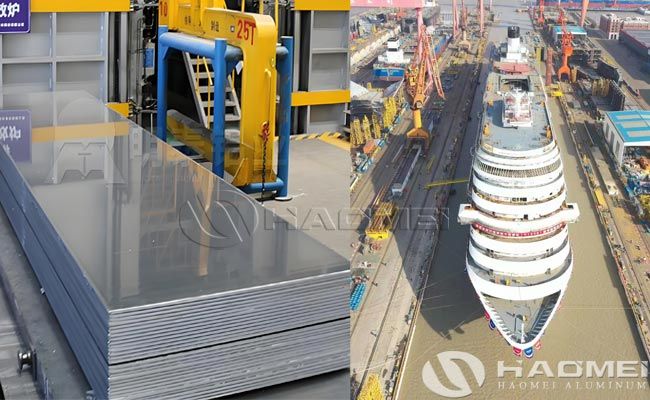
From the corrosion-resistant composition perspective, the corrosion resistance of 5083 aluminum alloy is built upon a precise ratio of high magnesium and low impurities. The magnesium content in the alloy is controlled at 4.0%~4.9%. Magnesium is dissolved in the aluminum matrix, significantly improving the density and self-healing properties of the surface oxide film. After minor scratches, a passivation layer can quickly regenerate, blocking chloride ion penetration. The addition of 0.4%~1.0% manganese and 0.05%~0.25% chromium refines the grains, optimizes the grain boundary structure, and reduces the risk of intergranular corrosion. Meanwhile, marine grade aluminum plates strictly limit impurity elements: copper ≤0.10%, iron ≤0.40%, silicon ≤0.40%, avoiding localized electrochemical corrosion caused by impurity phases and reducing the probability of pitting corrosion initiation from the source.
The heat treatment state is a key variable determining the actual corrosion resistance level of 5083 aluminum plates, and this is a selection detail I have repeatedly reminded customers to pay attention to over many years in the industry. Even within the 5083 aluminum alloy, under normal rolling conditions, continuous β-phase (Mg₂Al₃) easily precipitates at grain boundaries. Under the combined action of seawater and stress, this can quickly form intergranular corrosion channels, potentially leading to surface peeling within 3-5 years. The H116 temper, a standard for marine applications, undergoes strain hardening and low-temperature stabilization treatment to break down the β-phase at grain boundaries into discrete particles, effectively blocking corrosion propagation paths at the metallurgical level. It achieves a PB rating or higher in ASTM G66 exfoliation corrosion tests, a mass loss ≤15mg/cm² in ASTM G67 intergranular corrosion tests, shows no significant pitting or delamination in 1000 hours of neutral salt spray testing, and exhibits an annual corrosion rate of less than 0.01mm under long-term seawater splash conditions, with a service life exceeding 15 years.
In practical marine applications, 5083 corrosion-resistant aluminum sheets can cover structural parts of the entire ship with varying corrosion levels. For highly corrosive areas directly exposed to seawater, such as the hull and open decks, 5086 H116 aluminum plates can directly resist seawater infiltration and salt spray erosion. For moderately corrosive areas such as superstructures and bulkheads, more economical thickness specifications can be used. Even in harsh corrosive environments with alternating wet and dry conditions, such as ballast tanks, it maintains stable corrosion resistance, significantly reducing the frequency and cost of subsequent anti-corrosion maintenance.
Haomei 5083 aluminum sheet for boat strictly adhere to classification society material specifications, and each batch undergoes specialized corrosion testing. They hold mainstream certifications such as DNV, ABS, BV and CCS, and are available in thicknesses ranging from 3mm to 80mm, meeting the corrosion resistance requirements of various ship structures.
 |

Haomei Aluminum CO., LTD.

|
|
Company name: Haomei Aluminum CO., LTD.. Tel : +86-18137889531 Whatsapp : +86-18137889531 E-mail : nydia@aluminumhm.com