

What Grade Of Aluminium Is Used In Marine?
The high salt spray, strong corrosion, and alternating loads of the marine environment place stringent requirements on aluminum alloys used in ships. Combining material performance adaptability with industry application practices, marine grade aluminum alloys are primarily based on the 5000 series aluminum-magnesium alloys, supplemented by the 6000 series aluminum-magnesium-silicon alloys, with some high-end applications utilizing special grades, forming a precisely matched material selection system.
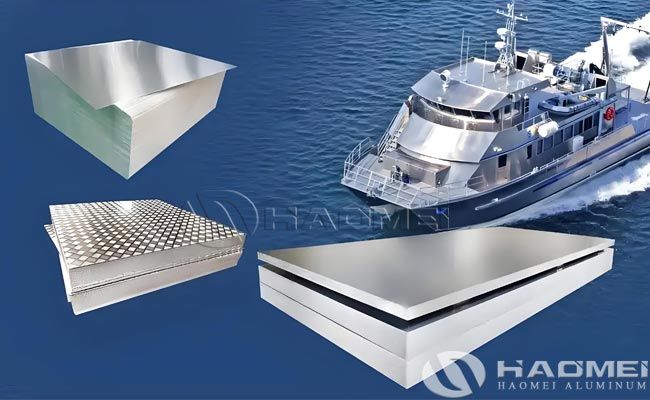
The 5000 series aluminum-magnesium alloy is the mainstream in shipbuilding. Magnesium is the core alloying element (content 2.5%-5.5%), combined with trace elements such as manganese and chromium to optimize performance. It possesses excellent seawater corrosion resistance, weldability, and stress corrosion resistance, and has no heat treatment strengthening characteristics, avoiding performance degradation in the weld heat-affected zone. The 5083 marine grade aluminum is considered the "benchmark of marine-grade aluminum alloys," containing 4.0%-4.9% magnesium and 0.4%-1.0% manganese, with a tensile strength ≥305MPa. It maintains toughness even at -196℃ and meets the requirements of ASTM B928 standard H116/H321. It is widely used in core load-bearing components such as ship hulls, decks, and offshore platforms. The corresponding domestic grade is 5A83 (formerly LF4).
The 5086 marine grade aluminum in the same series has a slightly lower magnesium content (3.5%-4.5%), a tensile strength of approximately 290MPa, and better plasticity and formability than 5083 aluminum. It is suitable for components requiring complex bending and welding, such as gangways, bulkheads, and refrigeration equipment. The 5052 marine grade aluminum has only 2.5% magnesium content, medium strength (tensile strength 230-240MPa), and controllable cost, and is mostly used in non-core load-bearing structures such as hulls of small vessels and oil pipelines. In high-end applications, marine grade aluminum 5059, with its 5.2% magnesium content and trace amounts of zirconium, boasts a tensile strength of 370 MPa and superior corrosion resistance compared to 5083, making it a preferred choice for high-performance vessels such as cruise ships and LNG carriers. Its impurity control and alloy proportioning technology are highly demanding, making it a core representative of high-end marine aluminum.
6000 series aluminum-magnesium-silicon alloys (representative grades 6061 and 6082) are strengthened through heat treatment, achieving a tensile strength of up to 310 MPa (6061-T6). They offer excellent machinability, but their corrosion resistance is weaker than the 5000 series marine grade aluminum. Anodizing and coating are necessary to enhance their protective capabilities. They are primarily used in components that do not directly contact seawater, such as superstructures, masts, and marine hardware, balancing strength and cost requirements. It is crucial to note that 2000 and 7000 series high-strength aluminum alloys have extremely poor corrosion resistance and are strictly prohibited from use in marine environments unless specially treated with anti-corrosion agents.
Material selection must adhere to the principle of "scenario suitability": 5083/5059 marine grade aluminum is preferred for underwater hull sections, 6061 marine grade aluminum with surface treatment is suitable for superstructures, and 5052 marine grade aluminum can be used for smaller vessels to control costs. Furthermore, even corrosion-resistant grades must be paired with coatings or sacrificial anode protection to meet the requirements of standards, reducing overall lifecycle maintenance costs.
Haomei Aluminum, leveraging precise composition control and condition regulation technology, can supply a full range of marine grade aluminum plates in bulk, meeting the material needs of various vessels from ordinary cargo ships to high-end cruise ships.
 |

Haomei Aluminum CO., LTD.

|
|
Company name: Haomei Aluminum CO., LTD.. Tel : +86-18137889531 Whatsapp : +86-18137889531 E-mail : nydia@aluminumhm.com