

Why Are Copper Nickel Pipe Flanges Used For Shipbuilding?
In marine seawater piping systems, flanges serve as critical pressure-bearing components for connecting pipes and equipment; the choice of material directly determines the sealing reliability and service life of the entire piping system. The shipbuilding industry adopts copper-nickel alloy flanges as the standard configuration for seawater piping based on a comprehensive assessment of three factors: corrosion resistance, electrochemical compatibility and structural reliability.
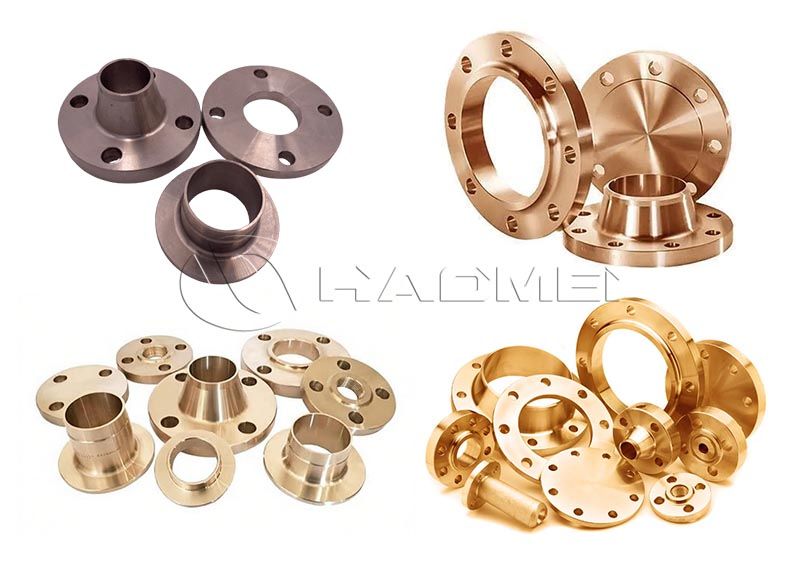
Resistance to seawater corrosion is the primary selection criterion.
Marine seawater flanges are constantly exposed to environments with high chloride ion concentrations. Carbon steel flanges exhibit an annual corrosion rate of 0.2–0.5 mm in seawater, with pitting corrosion on sealing surfaces leading to leaks within just 3–5 years. Stainless steel flanges are prone to pitting and crevice corrosion in chloride-rich environments—particularly in stagnant zones like the gaps between flanges and gaskets—where corrosion rates accelerate significantly. Copper-nickel flanges (grades 90/10 or 70/30) form a dense, cuprous oxide-based passivation film on their surface. Their annual corrosion rate in seawater is less than 0.02 mm, and their design service life exceeds 20 years—matching that of the piping itself—thereby preventing the flange from becoming a weak link in the system.
Electrochemical compatibility eliminates the risk of dissimilar metal corrosion.
When copper-nickel pipe is used, selecting carbon steel or stainless steel for the flanges creates an electrochemical potential difference between the two metals in seawater, causing the material with the more negative potential to corrode rapidly. Copper-nickel flanges share the same material grade as the piping, ensuring perfectly matched corrosion potentials and fundamentally eliminating galvanic corrosion caused by dissimilar metal contact. Furthermore, welding these components benefits from excellent fusion characteristics between identical materials; the weld microstructure is uniform, and the corrosion resistance of the welded joint matches that of the base metal, preventing the formation of new corrosion-prone weak points in the heat-affected zone.
Resistance to biofouling ensures long-term sealing performance.
Trace copper ions released from the surface of copper-nickel alloys inhibit the attachment of marine organisms such as barnacles, mussels, and algae. In seawater flange connections, biofouling accumulation can cause uneven stress on gasket sealing surfaces and localized corrosion or seizing of bolts, making disassembly and maintenance difficult after prolonged operation. Copper-nickel pipe flanges maintain smooth sealing surfaces even after extended service, facilitating easy gasket replacement and bolt maintenance, thereby significantly reducing piping maintenance man-hours during shipyard dry-docking.
Structural strength and sealing ratings comply with classification society standards.
Marine grade copper-nickel flanges are typically manufactured according to the ASME B16.5 standard, covering pressure ratings from Class 150 to Class 300, with higher pressure requirements met by increasing wall thickness. With yield strengths of approximately 105 MPa for 90/10 copper-nickel alloy and 140 MPa for 70/30 alloy—combined with precision machining of the sealing surfaces—these flanges maintain a tight seal even under shipboard vibration conditions. Major classification societies such as DNV, ABS, and LR include copper-nickel alloy flanges in their material specifications, requiring chemical composition and mechanical properties to match the associated piping, and mandating individual hydrostatic and penetrant testing.
Drawing on years of experience in the marine engineering supply sector, I recommend that purchasers specify in technical agreements that the flange grade must correspond exactly to the piping material and require material certification from the same heat/melt batch. Some projects adopt a cost-saving approach using carbon steel flanges with copper-nickel liners; however, crevice corrosion often occurs at the interface between the liner and the base material during operation, resulting in lower long-term reliability compared to solid copper-nickel flanges. The copper-nickel flanges we supply are forged from raw materials sharing the same heat number as the piping and adhere to ASME B16.5 dimensional standards. Haomei provide certification documents from classification societies like DNV and ABS and offer integrated delivery of flanges and matching piping, helping shipbuilders streamline procurement and inspection processes.
 |

Haomei Aluminum CO., LTD.

|

|
Company name: Haomei Aluminum CO., LTD.. Tel : +86-18137889531 Whatsapp : +86-18137889531 E-mail : nydia@aluminumhm.com