

Copper Nickel Elbow For Shipbuilding
Copper-nickel elbows are critical connecting fittings in marine seawater piping systems, primarily used to change the direction of pipelines; common angles include 45°, 90°, and 180°. In marine environments, elbow locations are susceptible to the combined effects of seawater impingement, turbulence, sediment erosion, and localized corrosion; consequently, high standards are required regarding material corrosion resistance, wall thickness uniformity, and weld quality.
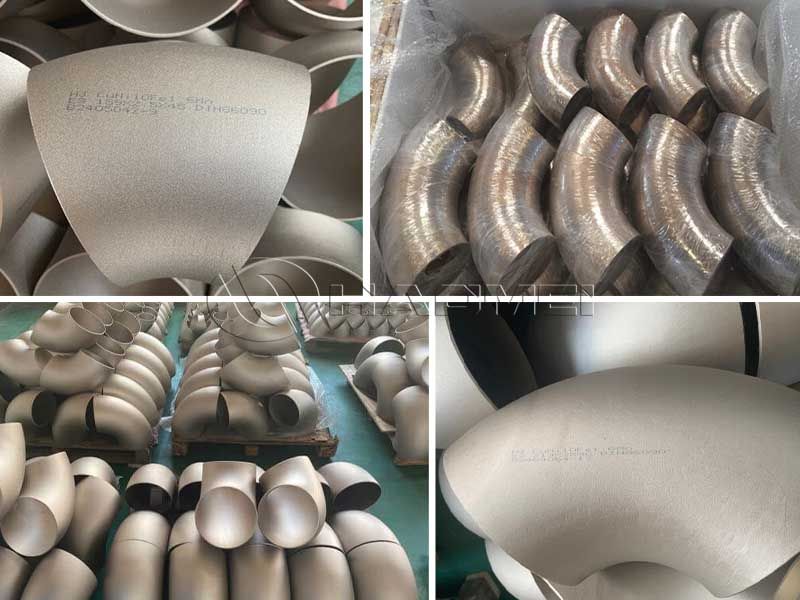
Marine copper-nickel elbows are typically manufactured from 90/10 and 70/30 copper-nickel alloys, corresponding to the common UNS grades C70600 and C71500. Both materials have a proven track record in engineering applications, serving systems such as seawater cooling, fire-fighting, ballast, bilge, desalination, and auxiliary power.
C70600: 90/10 Copper-Nickel Elbows
C70600 is commonly known as 90/10 copper-nickel alloy; it contains 9.0%–11.0% nickel, 1.0%–1.8% iron, and typically no more than 1.0% manganese, with the balance consisting primarily of copper. The iron content facilitates the formation of a stable, dense protective film on the material in seawater, thereby enhancing resistance to uniform corrosion and impingement corrosion.
90/10 Cu-Ni elbows are commonly used in general seawater piping, fire mains, ballast water lines, air-conditioning cooling water systems, bilge systems, and cooling lines for auxiliary equipment. This material offers excellent cold and hot workability as well as weldability, making it suitable for most commercial vessels, offshore support vessels, tugboats, and near-shore service vessels.
C71500: 70/30 Cu-Ni Elbows
C71500 is a 70/30 Cu-Ni alloy typically containing 29.0%–33.0% nickel, 0.4%–1.0% iron, and generally no more than 1.0% manganese. Its higher nickel content provides superior corrosion resistance in high-velocity seawater, elevated-temperature seawater, and media containing abrasive particles.
70/30 Cu-Ni elbows are frequently used in high-velocity seawater piping, desalination units, condenser circulation systems, main engine cooling water systems, seawater lift lines for offshore platforms, and critical pump station piping. As elbows are areas where fluid direction changes—often resulting in higher local flow velocities and turbulence intensity compared to straight pipe sections—the 70/30 Cu-Ni alloy offers a higher safety margin under these operating conditions.
Main Types of Marine Cu-Ni Elbows For Shipbuilding
Categorized by connection method, butt-weld elbows are the most common type of marine Cu-Ni elbow, encompassing both seamless and welded butt-weld varieties. The butt-weld configuration features a continuous inner wall and low flow resistance, making it suitable for medium-to-high-pressure and large-diameter seawater piping. For small-diameter instrumentation lines or equipment connections, socket-weld, threaded, or flanged elbows may also be used.
Categorized by bending radius, copper nickel elbows are classified into long-radius elbows and short-radius elbows. For long-radius 90° elbows, the distance from the center to the end face is typically 1.5 times the nominal diameter; this allows for a gentler change in fluid direction, resulting in lower pressure drop and reduced risk of localized erosion, making them suitable for seawater circulation mains and pump discharge lines. Short-radius elbows require less installation space and are often used where piping layout within compartments is constrained, though their use requires evaluation based on flow velocity and medium cleanliness.
Structurally, copper nickel elbows are also categorized into equal-diameter, reducing, single-segment, and multi-segment welded types. Reducing elbows can simultaneously facilitate a change in pipe diameter and direction, making them highly practical for equipment interfaces, pump connections, and compact modular piping systems.
Typical Applications in Shipbuilding
Cu-Ni elbows are primarily used in systems that come into direct contact with seawater or transport saline media over long periods. Typical locations include:
Seawater cooling lines for main engines, diesel generators, and gearboxes;
Seawater fire mains, deck washdown lines, and emergency fire-fighting systems;
Ballast water systems, bilge drainage systems, and seawater tank connection lines;
Cooling water circuits for air conditioning condensers, chillers, and fan coil units;
Seawater desalination units, evaporators, condensers, and pump inlets/outlets;
Offshore platforms, marine engineering equipment, and seawater lift systems.
Areas such as pump outlets, locations downstream of valves, tee junctions, and sharp bends are particularly susceptible to erosion-corrosion. Engineering practices typically prioritize the use of long-radius elbows, increased wall thickness, or the selection of C71500 alloy for high-velocity systems.
Performance Advantages of Cu-Ni Alloy Elbows
In seawater, Cu-Ni alloys gradually form a protective film based on cuprous oxide. Once stabilized, this film reduces the corrosion rate and inhibits marine biofouling to a certain extent. Compared to standard carbon steel fittings, Cu-Ni elbows minimize the shedding of corrosion products, wall thinning, and the frequency of maintenance in seawater environments.
In clean seawater service, the design flow velocity for 90/10 copper-nickel pipe is typically controlled at approximately 3–3.5 m/s, while 70/30 copper-nickel alloys can accommodate higher velocities of around 4–4.5 m/s. Specific velocity limits must be determined by considering factors such as temperature, suspended sand content, elbow radius, operating duration, and pipeline pressure. For systems characterized by high sand content, frequent start-stop cycles, or significant flow velocity fluctuations, particular attention should be paid to the risk of erosion on the inner radius and outer arc (extrados) of the elbows.
Dimensions, wall thicknesses, and inspection requirements for marine copper-nickel elbows are generally determined by project specifications. Common manufacturing and acceptance standards include ASTM, ASME, EN, GB, and classification society rules. For butt-weld products, key items for verification include material certificates, chemical composition, dimensional tolerances, wall thickness, non-destructive testing (NDT) requirements, and hydrostatic test records. C70600 is typically paired with ERCuNi filler metal, while C71500 often utilizes compatible fillers such as ERNiCu-7 to ensure the seawater corrosion resistance of the weld seam.
Haomei Aluminum supplies copper-nickel elbows (including C70600 and C71500 grades) and associated fittings. When selecting components, it is recommended to determine the elbow material and configuration based on classification society requirements, seawater flow velocity, pipeline pressure, connection type, and installation space; particular emphasis should be placed on material compatibility at pump outlets and areas subject to high turbulence.
 |

Haomei Aluminum CO., LTD.

|

|
Company name: Haomei Aluminum CO., LTD.. Tel : +86-18137889531 Whatsapp : +86-18137889531 E-mail : nydia@aluminumhm.com