

Types of Marine Copper Nickel Elbows
Copper nickel elbows are the most widely used pressure-bearing directional fittings in marine seawater piping systems, playing a crucial role in changing the direction of media flow and buffering local turbulence. Since the back of the elbow is the area with the most concentrated erosion corrosion in the pipeline, its material matching, specification selection, and workmanship quality directly determine the service life of the entire seawater pipeline. Marine copper nickel elbows are not a single standardized product, but rather can be divided into a complete type system based on four core dimensions: alloy grade, applicable standards, bending degree, and radius of curvature. Different types correspond to different operating conditions and installation scenarios, and each item must be matched to the pipeline design requirements during selection.
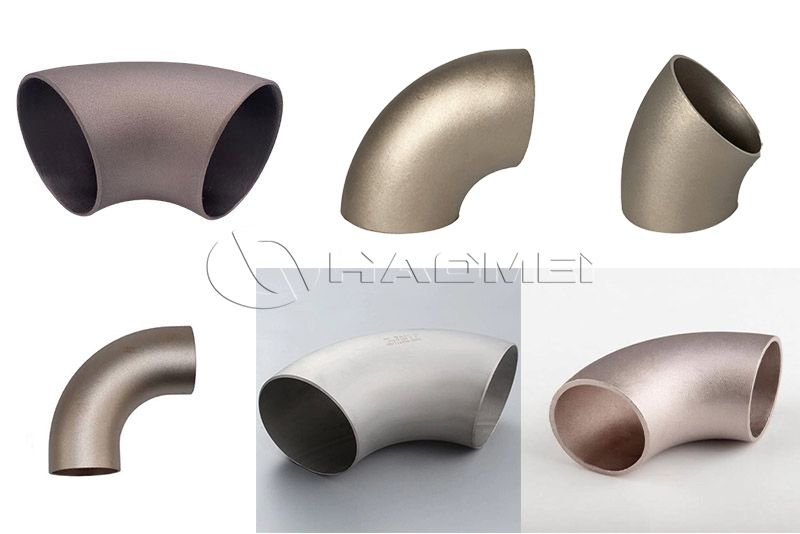
Based on alloy material, marine copper-nickel elbows are mainly divided into two types: 90/10 and 70/30, corresponding to different corrosion severity levels.
90/10 copper-nickel elbows (UNS C70600 / BFe10-1-1) are the mainstream type for marine seawater piping. With approximately 10% nickel content and added iron and manganese to enhance erosion resistance, they are suitable for seawater media with flow velocities ≤2.5m/s. They are widely used in fire protection systems, ballast water, domestic seawater, and medium- and low-pressure cooling circuits, offering the best overall cost-effectiveness and accounting for over 70% of total marine copper-nickel elbow usage.
70/30 copper-nickel elbows (UNS C71500 / BFe30-1-1) have an increased nickel content of 30%, significantly enhancing tensile strength and resistance to high-speed erosion corrosion. They are a high-load type, specifically designed for core circuits such as main seawater cooling systems, high-pressure water injection, and slurry piping. Especially in nearshore waters with high sand content or high-speed turbulent sections, their corrosion resistance life is approximately twice that of the 90/10 grade.
Based on the applicable standards system, marine copper-nickel elbows mainly follow three categories of specifications.
The most common is ASME B16.9, the standard for factory-manufactured welded pipe fittings, which clearly specifies dimensional tolerances, wall thickness classifications, and end beveling, and is the mainstream standard adopted in international shipbuilding and offshore engineering projects.
Domestic projects mostly use the GB/T 12459 standard for seamless welded steel pipe fittings, whose technical requirements basically correspond to the ASME system, and whose size series is compatible with domestic metric piping.
In addition, there are specific specifications from various classification societies, such as DNV-OS-B101 and ABS material specifications, which focus on additional marine requirements for material chemical composition, mechanical properties, corrosion resistance, and flaw detection levels. Export shipbuilding projects typically require elbows to meet both pipe fitting dimensional standards and classification society material certification requirements.
Based on the bending degree, marine copper-nickel elbows are divided into two main categories: standard degrees and non-standard degrees. 90° copper-nickel elbows are the most commonly used degree type, used for vertical pipeline changes, and are widely used in main and branch pipelines. 45° copper-nickel elbows are a small degree change type, with lower fluid resistance, and are often used for fine-tuning changes and space avoidance in long-distance pipelines. 180° copper-nickel elbows, also known as U-bends, are a type of reversal, mainly used for oil return, water return loops, or heat exchanger reversal pipelines. In addition to standard degrees, special degree types such as 30° and 60° can be customized according to pipeline layout to meet the pipeline layout requirements of complex compartments.
Based on the radius of curvature, marine copper-nickel elbows can be divided into two categories: long radius (LR) and short radius (SR).
Long radius elbows have a bending radius of 1.5 times the nominal diameter (R=1.5D), resulting in a smoother fluid transition, lower local resistance, and more uniform scouring wear on the back of the elbow. This type is recommended for marine seawater systems, and long radius designs are preferred for most operating conditions.
Short-radius elbows have a bending radius of 1 nominal diameter (R=1.0D), making them compact and space-saving. However, they involve sharp turns and strong local turbulence, resulting in a higher risk of erosion corrosion compared to long-radius elbows. They should only be used cautiously in secondary piping where space is limited and flow rates are low.
Regarding manufacturing quality, all types of marine copper-nickel elbows generally employ a hot-push forming process. This involves integral molding using medium-frequency heating and mandrel pushing, ensuring uniform wall thickness and intact metal flow lines on the back of the elbow. Finished products must pass wall thickness testing, penetrant testing, and hydrostatic testing. Critical batches also undergo intergranular corrosion testing. All types of marine copper-nickel elbows we supply use alloy raw materials from the same furnace as the pipe material and hold certifications from major classification societies such as DNV, ABS, and CCS. We offer various wall thickness grades, including SCH40 and SCH80, and can customize degrees to ensure material consistency and weld compatibility with the copper-nickel pipes in the same piping system.
 |

Haomei Aluminum CO., LTD.

|

|
Company name: Haomei Aluminum CO., LTD.. Tel : +86-18137889531 Whatsapp : +86-18137889531 E-mail : nydia@aluminumhm.com