

5083 H321 Marine Aluminum Plate For Shipbuilding
In marine grade aluminum alloy selection, 5083 H321 marine aluminum plate for shipbuilding is a dedicated grade optimized for the welding conditions of ship hull sections. Through precise control of internal stress and grain boundary structure via stabilization heat treatment, it significantly improves the long-term structural reliability after welding while ensuring marine corrosion resistance, making it the preferred material for ship hull structures with a high proportion of welding.
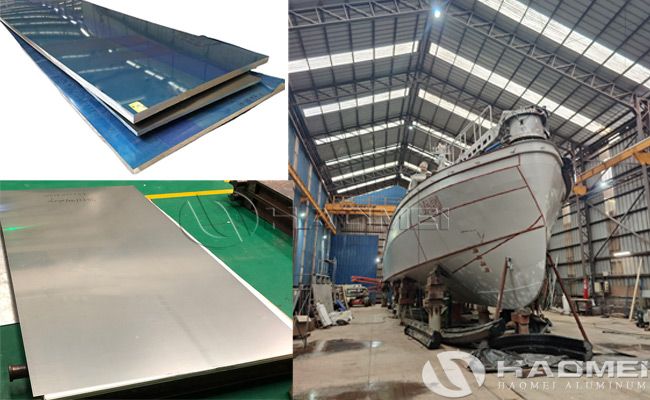
From the perspective of the alloy substrate, 5083-H321 aluminum plate adopts a marine-grade high-magnesium anti-rust aluminum system, with chemical composition strictly adhering to EN 573-3 standards: magnesium content 4.0%~4.9%, forming the core framework for a dense passivation film and giving the plate its inherent resistance to seawater corrosion; manganese content 0.4%~1.0%, and chromium content 0.05%~0.25%, synergistically refining grains and optimizing grain boundary phase distribution; impurities such as copper, iron, and silicon are strictly controlled within 0.10%, 0.40%, and 0.40%, respectively, reducing pitting and intergranular corrosion induction factors from the source. The finished product showed no significant pitting corrosion after 1000 hours of neutral salt spray testing, and the annual corrosion rate in the seawater splash zone was less than 0.012 mm, meeting the anti-corrosion requirements of ocean-going vessels throughout their entire life cycle.
The core value of the H321 temper of 5083 marine grade aluminum plate lies in solving the problem of stress corrosion cracking caused by the superposition of "welding residual stress + marine corrosion". This is also a selection experience I've summarized from years of serving shipbuilding clients: After welding ordinary rolled or H116 aluminum plates, residual stress concentrates around the weld, making them prone to corrosion cracking along grain boundaries in a chloride ion environment, gradually expanding and leading to structural failure. The H321 temper, through pre-strain hardening and low-temperature long-term stabilization treatment, eliminates residual stress within the plate beforehand, while simultaneously controlling the grain boundary β phase to a discrete and uniform distribution, blocking the stress corrosion propagation path. Even after high heat input welding, the stress corrosion resistance of the joint area can still maintain more than 80% of the base material, far superior to conventional temper aluminum plates.
In terms of mechanical properties, the tensile strength of 5083-H321 aluminum plates is stable at 290~360MPa, with a specified non-proportional elongation strength ≥180MPa and elongation after fracture ≥12%, balancing structural strength and cold formability. It can be cold-bent to meet the shaping requirements of curved hull plates, eliminating the need for heat forming and avoiding grain boundary phase degradation. Meanwhile, the aluminum sheet metal is flat and its thickness tolerance is controlled within ±0.15mm, making it suitable for the tooling requirements of automated welding production lines in shipbuilding and reducing on-site calibration work.
As a professional marine grade aluminum plate supplier, Haomei Aluminum implements full-process classification society quality control standards for its 5083-H321 sheet metal. Each batch passes specific tests for intergranular corrosion and stress corrosion, and the products are factory-approved by six major classification societies, including BV, DNV, ABS, RINA, LR, KR and CCS. Sheet metal thickness ranges from 4mm to 60mm, with a maximum width of 2600mm, supporting fixed-length cutting and bulk stocking, enabling rapid response to the segmented construction supply needs of global shipbuilders.
the core advantage of 5083 H321 marine aluminum plate for shipbuilding not lies in its extreme strength, but in its corrosion resistance stability under welding conditions. For weld-intensive structures such as the main hull side and bulkheads, it is a more reliable long-term choice than conventional methods.
 |

Haomei Aluminum CO., LTD.

|
|
Company name: Haomei Aluminum CO., LTD.. Tel : +86-18137889531 Whatsapp : +86-18137889531 E-mail : nydia@aluminumhm.com