

Types of Shipbuilding CuNi Tee
Copper nickel tees are core pressure-bearing pipe fittings in marine seawater piping systems, enabling the branching and merging of media. The fluid conditions at the junctions of branch pipes are complex, with strong turbulent shear forces, making them high-risk areas for erosion corrosion and stress concentration. In shipbuilding engineering, the selection of copper nickel tees directly affects the long-term operational reliability of core systems such as seawater cooling, fire protection and ballast. Based on three core dimensions—alloy material, applicable standards, and structural form—copper-nickel tees for shipbuilding can be divided into a complete type system. Different types correspond to different operating loads and installation requirements, necessitating precise matching with pipeline design parameters.
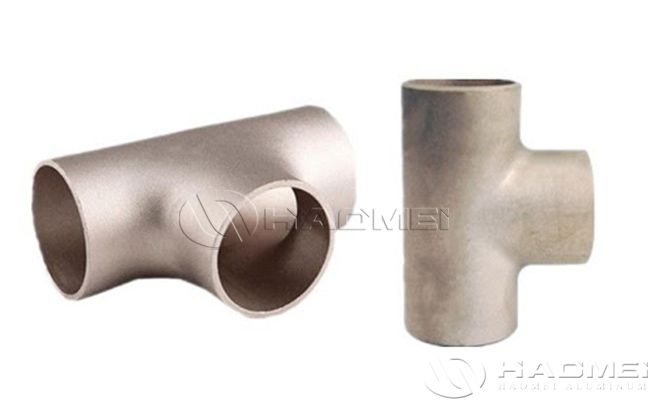
Based on alloy material, copper nickel tees for shipbuilding are mainly divided into two types, corresponding to different levels of corrosion resistance and pressure bearing requirements.
The 90/10 copper-nickel tee (UNS C70600 / BFe10-1-1) is the most widely used general-purpose product in shipbuilding. With a nickel content controlled at 9.5%~10.5%, it is enhanced with iron and manganese to improve erosion resistance. Suitable for conventional seawater conditions with flow velocities ≤2.5m/s, it is widely used in ship fire-fighting systems, ballast water pipelines, domestic seawater supply, and auxiliary cooling circuits. It offers a balanced performance and cost, making it suitable for mass production and installation throughout the ship.
The 70/30 copper-nickel tee (UNS C71500 / BFe30-1-1) is a high-load, corrosion-resistant type. With a nickel content increased to 29%~32%, its tensile strength and resistance to high-speed erosion are significantly enhanced. It can withstand media flow velocities above 3m/s and has superior resistance to pitting and crevice corrosion. It is specifically designed for core circuits such as main seawater cooling systems, main engine cooling branches, and high-pressure seawater injection pipelines, and is particularly suitable for vessels operating in near-shore, high-sand-content waters.
Based on the applicable standards, copper nickel tees for shipbuilding can be divided into three categories to meet the compliance requirements of different construction projects.
The first category is the ASME standard type, which follows the ASME B16.9 factory-manufactured welded pipe fitting dimensional standard and is compatible with the ASTM B466 seamless pipe material specification. Its dimensional tolerances, bevel types, and wall thickness classifications are all compatible with international piping systems, making it the mainstream type adopted for export ships and offshore engineering projects.
The second category is the national standard type, which follows the GB/T 12459 welded seamless pipe fitting standard and the GB/T 8890 copper-nickel alloy pipe standard. It uses metric dimensions and is compatible with domestic shipbuilding piping systems, primarily used in domestically built civilian vessels and near-shore engineering equipment.
The third category is the classification society certified type, which, in addition to the dimensional standards, meets the material specifications of mainstream classification societies such as DNV, ABS, LR, and CCS. It requires specific verification of chemical composition, mechanical properties, and corrosion performance, and must be issued a classification society approval certificate. This is a mandatory selection type for classed vessels.
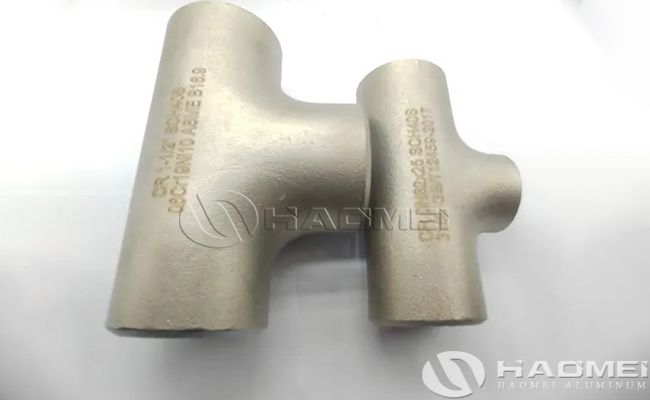
Based on structural form, shipbuilding copper-nickel tees are primarily divided into two categories: equal-diameter tees and unequal-diameter tees, adapting to different pipeline branching logics.
Equal-diameter tees, also known as equal tees, have all three ports with identical nominal diameters. The main pipe and branch pipes have the same wall thickness, resulting in uniform fluid distribution and symmetrical stress distribution. They are suitable for scenarios involving uniform flow branching and merging, such as branching fire-fighting loops on ships or parallel loops of the same specification. The manufacturing process is mature, making it the mainstream structure for mass production.
Unequal tees, also known as reducing tees, have different diameters between the main pipe and branch pipes. They primarily use a conventional "larger pipe to smaller pipe" structure, but multi-diameter combinations can also be customized. They are mainly used in scenarios where a smaller diameter branch branch originates from a larger diameter main pipe, such as branching equipment cooling pipes from a ship's main cooling trunk line or branching instrument sampling pipes from a main pipe. To reduce fluid scouring and stress concentration at the branching points, asymmetrical tees feature a smooth transition design on the inner wall, and the branch pipe roots are thickened to ensure pressure resistance is no less than that of the main pipe.
From a forming process perspective, shipbuilding copper-nickel tees mostly employ hydraulic bulging or hot pressing integrated forming processes to ensure complete metal flow lines and uniform wall thickness without excessive thinning. Haomei full range of shipbuilding copper nickel tees uses the same furnace number of virgin copper-nickel alloy base material. Each finished product undergoes dimensional verification, penetrant testing, and hydrostatic testing. We can provide customized supply covering all alloys, standards, and structural types, along with corresponding classification society certification documents, fully meeting the piping needs of various ship construction projects.
 |

Haomei Aluminum CO., LTD.

|

|
Company name: Haomei Aluminum CO., LTD.. Tel : +86-18137889531 Whatsapp : +86-18137889531 E-mail : nydia@aluminumhm.com