

Aluminum Tee Sections for Ship Structures
With the industry trend of lightweight shipbuilding, aluminum structural profiles are gradually replacing traditional steel profiles, becoming the core load-bearing components of superstructures in high-speed ships, yachts, and offshore platforms. Among them, aluminum Tee sections, with their comprehensive advantages of reasonable cross-sectional stress distribution, high structural efficiency, and convenient installation, are the most widely used profile category in ship skeletal systems. They bear the core functions of transmitting structural loads, maintaining hull stiffness, and supporting the enclosure structure. Their performance directly determines the safety and service life of the ship structure.
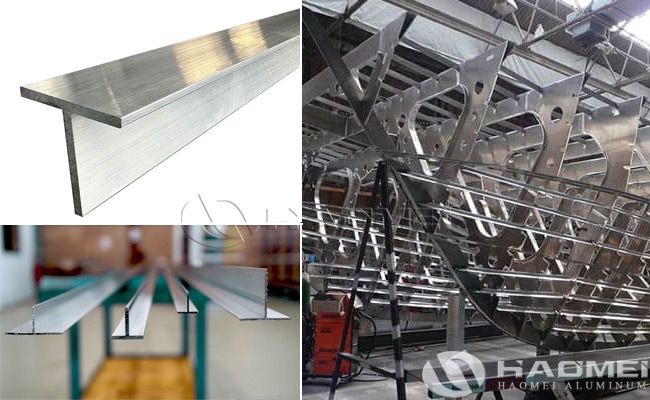
From the perspective of cross-sectional mechanical properties, aluminum Tee sections are open thin-walled load-bearing components, integrally formed by a vertical web and horizontal flanges to create a T-shaped cross-section. The section modulus and moment of inertia distribution are highly adapted to bending and shear conditions. The flanges, located on the outermost side of the cross-section, mainly bear the axial tensile and compressive stresses generated by bending, while the web bears the shear force and maintains cross-sectional stability. The structural load-bearing efficiency per unit weight is far higher than that of flat plate splicing structures. Compared to steel T-sections with the same load-bearing capacity, aluminum T-sections have a density only one-third that of steel, resulting in an overall weight reduction of over 45%. This effectively lowers the ship's center of gravity, improves stability, and increases effective payload, making them particularly valuable for high-speed vessels and special-purpose vessels with limited load capacity.
In terms of specifications, marine aluminum T-sections have a standardized size series, while also supporting customized mold opening to adapt to special structural designs. Conventional extruded T-sections have web heights ranging from 50mm to 350mm, flange widths from 30mm to 180mm, web wall thicknesses from 3mm to 12mm, and flange wall thicknesses from 4mm to 16mm. The appropriate cross-sectional specifications can be selected based on structural stress calculations. Small-sized aluminum T-sections (web height ≤ 100mm) are primarily used for bulkhead reinforcement and interior support frames; medium-sized sections (web height 100mm~200mm) are the mainstream choice for deck longitudinals and side girder members; large-sized sections (web height > 200mm) are used for core load-bearing components such as main deck beams and superstructure beams. Standard lengths are 6m and 12m, but extra-long lengths can be customized according to ship section dimensions to reduce on-site splicing and welding, improving structural integrity and construction efficiency.
The alloy selection for marine aluminum Tee sections follows the principle of "matching operating conditions and performance," and is mainly divided into two major alloy systems.
5083-H111 aluminum T-sections are the preferred grade for ship external structures. Belonging to the aluminum-magnesium rust-resistant alloy family, with a magnesium content controlled between 4.0% and 4.9%, and supplemented with manganese and chromium to refine the grain, they possess excellent resistance to marine salt spray and seawater splash corrosion. They exhibit excellent weldability, with minimal degradation of corrosion resistance in the heat-affected zone after welding, allowing for long-term service without additional anti-corrosion coating. Widely used in exposed areas such as side longitudinals, deck beams, and superstructure bulkhead frames, they are currently the most widely used type of marine aluminum profiles.
6082-T6 aluminum T-sections are heat-treated and strengthened alloys, with high strength and high precision as their core advantages. Yield strength can reach over 260 MPa, with high dimensional accuracy, strong resistance to deformation, and excellent machinability. This grade is more suitable for internal load-bearing structures bearing concentrated loads, such as ship equipment base frames, support columns, mast trusses, and cabin load-bearing beams, providing higher structural load-bearing capacity within limited cross-sectional dimensions. It should be noted that the strength of 6-series alloys decreases after welding. Therefore, a safety factor must be specifically included in the design, or a prefabricated bolt assembly structure should be adopted.
Marine grade aluminum T-sections have strict classification society specifications for manufacturing processes and quality control. Production utilizes a large-tonnage extrusion press for one-time hot extrusion forming, ensuring continuous and complete metal flow lines and eliminating stress concentration caused by weld seams. 5000 series aluminum profiles undergo tensile straightening and stabilization treatments to eliminate internal residual stress. 6000 series aluminum profiles undergo a complete heat treatment process of online quenching and artificial aging to ensure uniform cross-sectional mechanical properties.
As a professional marine aluminum profile manufacturer, we can provide a full range of specifications and alloys of aluminum T-sections. Our products are certified by major classification societies such as DNV, ABS, and CCS, and are suitable for the construction needs of various ships and offshore structures.
 |

Haomei Aluminum CO., LTD.

|

|
Company name: Haomei Aluminum CO., LTD.. Tel : +86-18137889531 Whatsapp : +86-18137889531 E-mail : nydia@aluminumhm.com