

EN AW-5083 H116 Marine Grade Aluminum Sheet
In the European standard system for marine aluminum materials, EN AW-5083 H116 is the most widely recognized and applied aluminum sheet grade for hull structures. It is also a marine-grade aluminum alloy material explicitly specified by major European classification societies such as DNV, LR, and BV. Many procurement projects often only specify "5083 marine aluminum sheet" while omitting the heat treatment requirements. However, in actual marine applications, the H116 heat treatment is the core factor determining the long-term reliability of the aluminum plate against marine corrosion. This is a key selection point I frequently remind clients of over many years of export supply—focusing solely on the alloy grade without considering the heat treatment condition can easily create long-term corrosion risks for the hull structure.
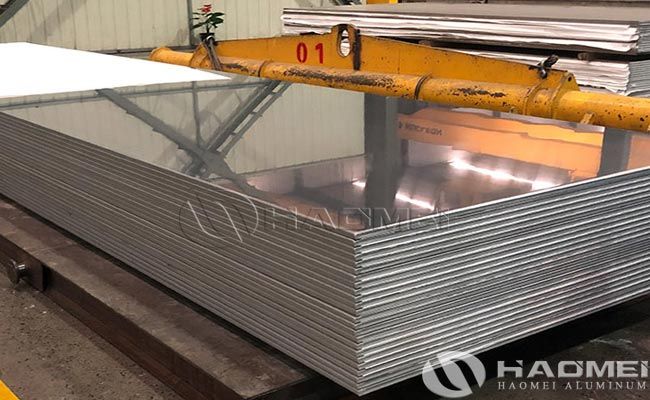
From a standard perspective, EN AW-5083 corresponds to the AlMg4.5Mn0.7 alloy in the European aluminum standard EN 573-3, and the product dimensions and performance comply with the EN 485 series standards. Its chemical composition is strictly controlled within a certain range: magnesium content 4.0%~4.9%, providing the core strength and corrosion resistance of the alloy; manganese content 0.4%~1.0%, assisting in strengthening and improving intergranular corrosion resistance; chromium content 0.05%~0.25%, used to refine grains and improve stress corrosion resistance; at the same time, copper is strictly limited to ≤0.10%, and iron and silicon to ≤0.40% each, to avoid impurities damaging the integrity of the passivation film, ensuring adaptability to marine environments through compositional ratio.
The technical essence of the H116 temper is to regulate the morphology and distribution of the β phase (Mg₂Al₃) at the alloy grain boundaries through controlled strain hardening and low-temperature stabilization treatment. Ordinary H112 temper undergoes only a small amount of work hardening, and the grain boundaries are prone to continuous β phase precipitation. Under the combined action of seawater chloride ions and structural stress, corrosion propagation along the grain boundaries easily occurs, leading to spalling. The H116 temper, through a stabilization process, disperses the β phase into discrete particles, blocking intergranular corrosion channels at the metallurgical level while retaining appropriate mechanical strength. According to the ASTM G67 nitric acid mass loss test, its intergranular corrosion mass loss is ≤15mg/cm²; according to the ASTM G66 exfoliation corrosion test, it can reach PB level or above, fully meeting the anti-corrosion requirements under long-term seawater splash and salt spray immersion conditions.
In terms of core mechanical properties, EN AW 5083 H116 aluminum plate has clear lower limits: tensile strength at room temperature 305~380MPa, specified non-proportional elongation strength ≥215MPa, and elongation after fracture ≥10%, balancing structural strength and forming toughness. This alloy has a density of only 2.66g/cm³, reducing weight by over 60% compared to hull steel of the same strength, effectively lowering the ship's center of gravity and improving stability and load-bearing capacity. Simultaneously, it exhibits excellent low-temperature toughness, maintaining good plasticity even at -60℃, with no risk of low-temperature embrittlement, making it suitable for polar vessels and cryogenic storage and transportation equipment. In terms of welding, when used with ER5183 or ER5356 welding wire, the weld joint coefficient can reach over 85% of the base material, and the corrosion resistance degradation in the weld area is minimal, making it suitable for hull section welding construction processes.
From a compliance perspective, the requirements for marine grade aluminum sheets for classed vessels go far beyond simply "component compliance." Our EN AW-5083 H116 marine aluminum sheets have been approved by the factories of six major classification societies, including DNV, ABS, LR, and CCS. Each batch of products can be issued with an EN 10204 3.1 material certificate, and a 3.2 certificate can be issued with third-party witnessed inspection, fully covering the shipbuilding drawing review and classification inspection process. Product thickness ranges from 3mm to 80mm, and the maximum width is up to 2600mm. Custom cutting and surface pretreatment are supported. We maintain a regular inventory of standard marine specifications, enabling rapid response to bulk procurement needs from overseas shipyards.
Based on my personal industry experience, the core principle for selecting marine aluminum sheets is always "condition takes precedence over grade." While both are made of 5083 aluminum alloy, H116 and ordinary H112 have similar procurement costs. However, over a hull service life of more than 10 years, the difference in resistance to spalling corrosion will directly affect structural lifespan and maintenance costs. For hull shells, open decks, and side structures that are exposed to the marine environment for extended periods, EN AW-5083 H116 marine aluminum sheet remains the most reliable and compliant choice.
 |

Haomei Aluminum CO., LTD.

|

|
Company name: Haomei Aluminum CO., LTD.. Tel : +86-18137889531 Whatsapp : +86-18137889531 E-mail : nydia@aluminumhm.com