

Corrosion Resistant Behaviour of Aluminium In Salt Water
Haomei Aluminum, specializing in the export of aluminum alloys for marine applications, understands the severe challenges that seawater environments pose to materials. Aluminum alloys, with their unique passivation mechanisms and alloying advantages, have become the preferred materials for the global shipbuilding industry. The following analysis, from a professional perspective, examines the corrosion resistant behaviour of aluminium in salt water, high corrosion-resistant alloys, and marine applications, providing reliable material selection references for your shipbuilding.
I. Corrosion Resistance Mechanism and Behaviour of Aluminum in Salt Water
The corrosion resistance of aluminum in seawater stems from the spontaneous formation of a dense alumina passivation film on its surface. This Al₂O₃ film, only 2-10 nm thick, effectively isolates seawater corrosion and possesses a certain degree of self-healing ability. In the weakly alkaline environment of seawater (pH 7.5-8.4), the electrode potential of aluminum is approximately -0.8V, placing it in the passivation zone with an extremely low corrosion rate.
In practical applications, the main forms of corrosion for aluminum are pitting corrosion, crevice corrosion, and exfoliation corrosion, all of which are related to the destruction of the passivation film by Cl⁻ ions. Pitting corrosion mainly occurs in the splash zone, with a rate of approximately 0.1-0.5 mm/year. In the fully immersed zone, due to reduced dissolved oxygen, the corrosion rate drops to 0.01-0.1 mm/year. In deep-sea environments (below 800m), the corrosion rate further decreases to 0.9-1.4 μm/year. Compared to steel, aluminum has a corrosion rate 5-10 times lower in seawater, and its corrosion products are non-scabbing, thus not accelerating structural damage.
II. Aluminum Alloy Grades and Properties Performing Excellently in Seawater
Based on export experience, 5000 series Al-Mg alloys are the mainstream aluminum alloys used in shipbuilding, with 5083, 5086, 5059, and 5456 performing the best. Some 6000 series aluminum alloys are also suitable for specific applications.
The 5083-H116/H321 aluminum alloy has a core composition of Al-4.5Mg-0.7Mn, a tensile strength of 300-350MPa, and an elongation of no less than 12%. It maintains good toughness even at -196℃, exhibits superior resistance to pitting and stress corrosion, and the corrosion resistance of welded joints is consistent with the base material. It is one of our largest-exported marine aluminum alloy grades.
The 5086 aluminum alloy has an Al-4.0Mg-0.5Mn composition. While its strength is slightly lower than 5083, it offers better machinability and excellent resistance to crevice corrosion, making it ideal for welding complex ship structures.
The 5059 aluminum alloy incorporates Zr, with a core composition of Al-5.1Mg-0.6Mn-0.15Zr. It not only boasts higher strength but also excellent fatigue resistance, with a corrosion rate of only 0.8μm/year in deep-sea environments, meeting the stringent requirements of ocean-going vessels.
Alloy 5456 has the highest magnesium content, with its core composition being Al-5.1Mg-0.8Mn. Its strength is close to that of 5083, and its greatest advantage is its outstanding resistance to erosion, making it suitable for high-stress components in ships. These alloys all utilize the synergistic effect of Mg and Mn elements to enhance the stability of the passivation film, effectively inhibiting intergranular corrosion and stress corrosion cracking, meeting the requirements of ships operating in long-term marine environments.
III. Application Scenarios of High Corrosion-Resistant Aluminum Alloys in Ships
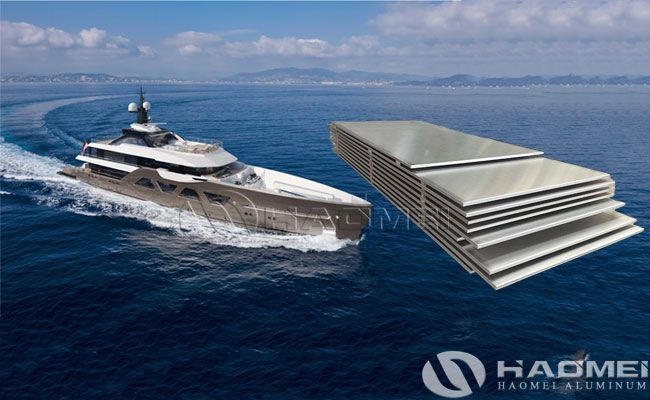
Based on experience from hundreds of shipbuilding projects worldwide, Haomei Aluminum's 5000 series marine grade aluminum alloys have been widely used in key components of various ships. In terms of hull structure, 5083-H321 is the preferred choice for hull skins of high-speed ships, yachts, and ro-ro passenger ships. For example, Asia's first all-aluminum alloy ro-ro passenger ship achieved a 40% weight reduction and a 15% increase in speed using this alloy. Its excellent low-temperature toughness also makes it suitable for LNG carrier cargo tanks.
In the superstructure sector, 5086 aluminum alloy, due to its excellent formability and weldability, is widely used in ship decks, bulkheads, and railings. One 100,000-ton liquefied gas carrier used 1200 tons of this alloy, significantly lowering the ship's center of gravity and improving navigation stability.
In special component applications, 5059 alloy is mostly used in the hulls of deep-sea exploration vessels, 5456 alloy is suitable for hydrofoil wing plates and high-speed ship propeller bushings, and 5052 alloy is used in ship interiors, ventilation ducts, and corrosion-resistant containers.
Furthermore, 6061-T6 alloy is used in ship crane booms and mooring equipment, and 6082 alloy is used in marine piping systems, balancing strength and corrosion resistance to meet the requirements of ship equipment.
Aluminum's corrosion resistance in seawater stems from its passivation film protection. 5000 series Al-Mg alloys, with their optimized composition, have become the preferred choice for ships, achieving significant advantages such as weight reduction of 40-50% and fuel efficiency improvement of over 30%. As a professional exporter, Haomei Aluminum offers a full range of marine grade aluminum alloys conforming to ASTM B928 standards, along with welding process guidelines and corrosion protection solutions. Its products have served over 200 marine projects in Asia, Europe, and the Middle East. Choosing Haomei means choosing the perfect balance of lightweight design, high corrosion resistance, and long-term economic benefits, providing reliable protection for your vessels in global waters.
 |

Haomei Aluminum CO., LTD.

|

|
Company name: Haomei Aluminum CO., LTD.. Tel : +86-18137889531 Whatsapp : +86-18137889531 E-mail : nydia@aluminumhm.com